Moon phase today
Discover today's lunar phase. Get up-to-date information on the Moon's movement, a detailed lunar phase calendar, and fascinating facts for sky watchers.What is the current lunar phase?
The current moon phase is «Waning Gibbous»
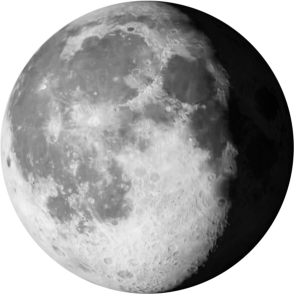
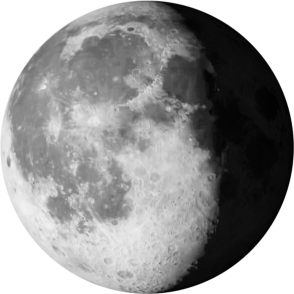
Moon Phases Calendar for the Current Month, july 2025
| Mo | Tu | We | Th | Fr | Sa | Su |
|---|---|---|---|---|---|---|
|
1
 |
2
 |
3
 |
4
 |
5
 |
6
 |
|
|
7
 |
8
 |
9
 |
10
 |
11
 |
12
 |
13
 |
|
14
 |
15
 |
16
 |
17
 |
18
 |
19
 |
20
 |
|
21
 |
22
 |
23
 |
24
 |
25
 |
26
 |
27
 |
|
28
 |
29
 |
30
 |
31
 |
The lunar calendar is a timekeeping system based on the cyclic movement of the Moon around the Earth. Unlike the solar calendar, which is based on the Earth's movement around the Sun, the lunar calendar takes into account the phases of the Moon and its position relative to the Earth and the Sun. In astronomy, the lunar calendar is important because it allows for accurate tracking of changes in the Moon's position and its influence on various astronomical phenomena.
Main Phases of the Moon
The lunar cycle, or synodic month, lasts about 29.5 days and includes four main phases: new moon, first quarter, full moon, and last quarter. These phases are determined by the position of the Moon relative to the Earth and the Sun.
- New Moon: In this phase, the Moon is between the Earth and the Sun, and its illuminated side is facing away from us. As a result, the Moon is almost invisible in the sky. The new moon occurs when the longitude of the Moon and the Sun coincide, marking the beginning of a new lunar cycle.
- First Quarter: About a week after the new moon, the Moon moves a quarter of the way around the Earth, and half of its disk is illuminated. At this point, the Moon is visible in the sky in the evening and at night. The first quarter occurs when the difference in longitude between the Moon and the Sun is 90 degrees.
- Full Moon: Two weeks after the new moon, the Moon is on the opposite side of the Earth from the Sun, and its disk is fully illuminated. The full moon occurs when the longitude of the Moon and the Sun differ by 180 degrees. At this time, the Moon is visible all night and reaches its maximum brightness.
- Last Quarter: About three weeks after the new moon, the Moon moves another quarter of the way around the Earth, and half of its disk is illuminated, but now it is waning. The last quarter occurs when the difference in longitude between the Moon and the Sun is 270 degrees. The Moon is visible in the sky after midnight and in the morning.
Schematic Representation of the Moon's Movement Around the Earth

The Sun is on the left, and the Earth and Moon are on the right. In the diagram, the Earth is oriented with the North Pole facing us, so the Moon orbits the Earth counterclockwise. The illuminated areas are visible on the diagram. This is the current position of the objects, and their positions on the diagram are calculated and displayed in real-time. The scales are, of course, not preserved; otherwise, all objects (except the Sun) would be depicted as dots on a black background.
The Lunar Cycle and Its Influence on Earth
The lunar cycle has a significant impact on Earth and various natural phenomena. One of the most well-known effects of the Moon is tides. The gravitational pull of the Moon causes fluctuations in water levels in the oceans, leading to tides. These phenomena play an important role in coastal ecosystems and affect the lives of marine organisms.
Additionally, the Moon affects the illumination of the night sky. Depending on the phase of the Moon, the night sky can be brightly lit or almost completely dark. This affects astronomical observations, as the bright light of the Moon can make it difficult to observe faint objects such as distant stars and galaxies.
Lunar Eclipses
Lunar eclipses occur when the Earth is between the Sun and the Moon, and the Earth's shadow falls on the Moon. Lunar eclipses can be total, partial, or penumbral, depending on how much of the Moon is immersed in the Earth's shadow.
- Total Lunar Eclipse: Occurs when the Moon is completely immersed in the Earth's shadow. At this time, the Moon may take on a reddish hue due to the scattering of sunlight in the Earth's atmosphere. This phenomenon is known as a "blood moon."
- Partial Lunar Eclipse: Occurs when only part of the Moon is immersed in the Earth's shadow. In this case, a dark shadow is visible on the Moon, gradually moving across its surface.
- Penumbral Lunar Eclipse: Occurs when the Moon passes through the Earth's penumbra, and its illumination slightly decreases. This eclipse is less noticeable than a total or partial one.
The Lunar Calendar in Astronomy
The lunar calendar is used by astronomers to accurately track the phases of the Moon and plan observations. For example, astronomers can use the lunar calendar to determine favorable nights for observing stars and planets when the Moon will not interfere with its light.
Additionally, the lunar calendar is important for planning space missions. For example, when planning missions to the Moon or other planets, the phases of the Moon and its position relative to the Earth and the Sun are taken into account. This allows for optimizing flight trajectories and minimizing risks.
Lunar Cycles and Their Influence on Climate
Research shows that lunar cycles can influence the Earth's climate. For example, tides caused by the gravitational pull of the Moon can affect the circulation of ocean currents and, consequently, climatic conditions. Additionally, changes in the illumination of the night sky can affect the behavior of animals and plants, which can also impact ecosystems.
The Lunar Calendar and Its Importance for Science
The lunar calendar is important for science because it allows for accurate tracking of changes in the Moon's position and its influence on various natural phenomena. This helps scientists better understand processes occurring on Earth and in space and develop new methods of observation and research.
For example, studying lunar cycles and their influence on tides helps scientists better understand the dynamics of the oceans and their role in the Earth's climate system. Additionally, research on lunar eclipses and other astronomical phenomena helps scientists develop new methods of observation and data analysis.
Conclusion
The lunar calendar is an important tool for astronomy and science in general. It allows for accurate tracking of the phases of the Moon and its influence on various natural phenomena, helping scientists better understand processes occurring on Earth and in space. The lunar calendar also plays an important role in planning space missions and observations, contributing to the development of science and technology. Whether used for astronomical observations, planning space missions, or climate research, the lunar calendar remains an important tool for science and helps us better understand the world around us.